
What is Electron Application Upgrade?
Electron application is an update mechanism where version files are hosted in the system by developers, suitable for scenarios where a unified system is needed to maintain the version file release process. It is fully compatible with the official Electron dynamic update interface and allows for quick integration.
Core Concepts
Autonomous Version Hosting
Store the application's version installation packages (exe/dmg, etc.) in the system, allowing developers to independently manage the version release process.
Integration Flowchart
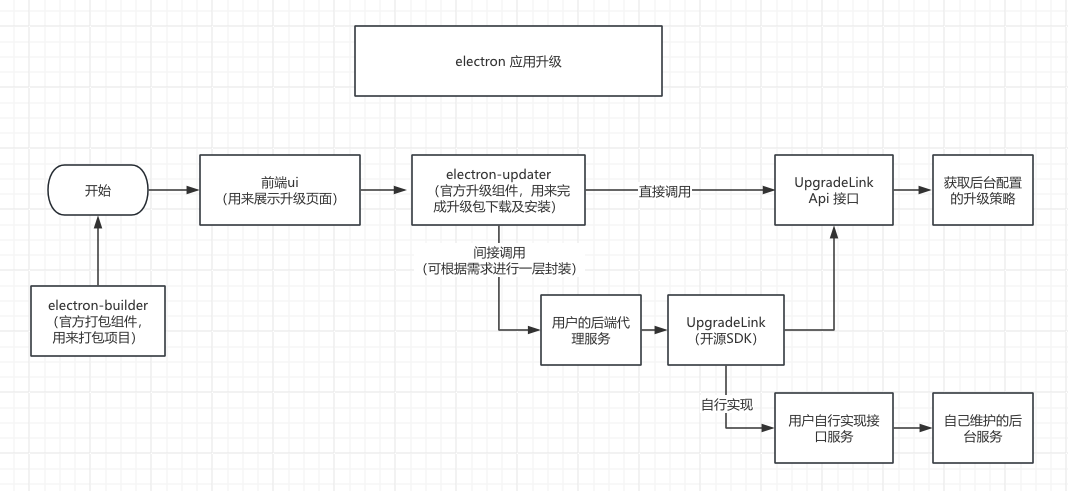
1. Core Concepts
1.1 Electron Application Version File Hosting Platform
The core logic is to proactively upload the application's "application installation package" (EXE/DMG, etc.) or "update files" to the UpgradeLink system. The UpgradeLink system uniformly handles file storage, version management, and download link maintenance, allowing clients to actively request verification and download from the system.
Version file hosting carrier: Uniquely relies on the UpgradeLink system. All update files are centrally hosted by this system, and developers do not need to worry about underlying operation work such as file storage server setup and access stability.
2. Typical Workflow
- Developer preprocessing: Upload the application installation package or custom update file to the UpgradeLink system. The system automatically generates the corresponding file identifier and download-related information (such as version number association, file metadata, etc.);
- Modify the configuration items of the Electron official update component on the client side and fill in the relevant information from the UpgradeLink system.
- Call the Electron official update component to complete the application update.
3. Key Implementation Points
Version Hosting Configuration Specifications
- File upload requirements: Application installation packages or update files must be uploaded according to the format and size limits specified by the UpgradeLink system to ensure file integrity and availability;
- System configuration points: After uploading files, version information (such as version number, update log, etc.) must be entered into the UpgradeLink system. The system will automatically associate files with version information and generate corresponding query and download links;
- Client configuration: In the client update module, configure the file query interface address or file unique identifier provided by the UpgradeLink system to ensure the client can normally send requests to the system, obtain file information, and download files.
4. Advantages and Features
- Full process control: Independently determine the release rhythm, version history retention, and update strategy. File hosting and distribution are guaranteed by the UpgradeLink system, balancing control and operation convenience;
- Extremely low operation costs: No need to build/maintain any file storage and download servers. Rely on the UpgradeLink system to complete full-link file management, greatly reducing operation pressure;
- High flexibility: Support phased rollouts (implemented by configuring different file distribution scopes through the UpgradeLink system), channel-specific updates (configure multiple sets of files and version information in the system), and emergency hotfixes (quickly update corresponding files and versions in the system without adjusting the client);
- Cross-platform universal: The same core logic can be adapted to multiple terminals such as Windows, macOS, and Linux (requires adaptation to each system's installation permissions). The UpgradeLink system uniformly provides cross-terminal compatible download links;
- Easy reuse and expansion: Core update logic can be encapsulated as a general module. Different projects only need to replace it with the "Electron application unique identifier" of the corresponding project in the UpgradeLink system to quickly access.